
Vision, Mission & Values
Presidential Vision
Mission
The Institute for Clinical Social Work (ICSW) exists to advance the practice and understanding of clinical social work and counseling through rigorous graduate education rooted in contemporary psychodynamic and psychoanalytic thought. We are committed to developing skilled, reflective clinicians, scholars, and researchers who are equipped to meet the psychological needs of individuals, families, and communities within an ever-changing and complex social landscape.
Vision
To be the leading institution in psychodynamic clinical education, fostering a deep understanding of contemporary psychodynamic and psychoanalytic frameworks and their application in contemporary practice. We aim to cultivate a community of professionals who are committed to lifelong learning, critical thinking, and the advancement of psychodynamic knowledge.
Excellence in Education
We provide comprehensive training in the practical skills of psychotherapy from a psychoanalytic/psychodynamic perspective.
Fairness and Justice
We teach critical social theories that enable our graduates to work effectively with diverse communities within a modern context.
Innovation and Leadership
We strive to produce practitioners, scholars, researchers, educators, and leaders who are at the forefront of psychodynamic clinical practice and research.
Contemporary Approach
We emphasize teaching psychodynamic concepts from a contemporary perspective, ensuring our graduates are well-equipped to meet the challenges of today’s world.
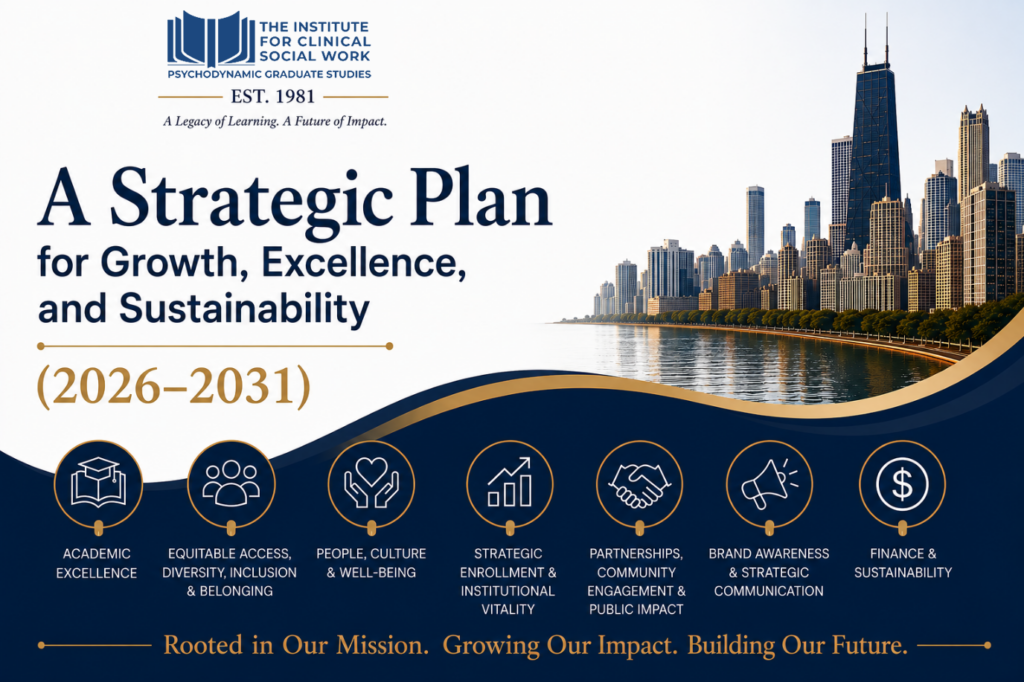
Pillar 1: Academic Excellence, Innovation, & Student Success
Priority 1: Curriculum Relevance & Program Growth
KPI's
- PhD Program Review completed; ≥75% recommendations implemented by 2029
- Add 1 new academic or certificate program by 2031
- ≥85% student satisfaction on curriculum quality
- +15% growth in continuing education by 2031
TIMELINE
Year 1:
Complete PhD review
Year 2-3:
Launch new program; expand CE offerings
Year 4-5:
Evaluate impact; scale successful programs
Priority 2: Student Success & Support
KPI's
- Student Advisory Council active with quarterly engagement by 2027
- Biannual student feedback loop implemented and tracked
- Retention/graduation rates increase by 10% by 2030
- Scholarship funding +25% by 2031
TIMELINE
Year 1:
Launch Advisory Council; establish feedback systems
Year 2-3:
Expand scholarships; track retention gains
Year 4-5:
Close equity gaps; sustain outcomes
Priority 3: Field Education & Partnerships
KPI's
- Field placement review completed by 2027
- +10 high-quality community partnerships by 2030
- +25% increase in diverse placement sites
- ≥90% student satisfaction in field education
TIMELINE
Year 1:
Conduct field audit
Year 2-3:
Build partnerships; diversify placements
Year 4-5:
Sustain and evaluate quality
Priority 4: Faculty Excellence & Teaching Innovation
KPI's
- Faculty onboarding program launched by 2027
- 3–4 faculty development offerings annually (≥75% participation)
- Measurable increase in faculty diversity by 2031
TIMELINE
Year 1:
Launch onboarding and training structure
Year 2-3:
Expand development and recruitment
Year 4-5:
Sustain diversity and excellence
Priority 5: Learning Innovation & Communication
KPI's
- Launch institutional newsletter by 2027
- Develop 2–3 hybrid/online offerings by 2029
- +15–20% improvement in student experience/communication satisfaction
TIMELINE
Year 1:
Launch communication platforms
Year 2-3:
Develop hybrid/online courses
Year 4-5:
Evaluate and refine student experience
PILLAR 2: Equitable Access, Diversity, Inclusion & Belonging (EDIB)
Priority 1: Access & Affordability
KPI's
- Increase enrollment of underrepresented students annually
- Expand need-based aid (tracked yearly growth)
- Reduce retention gaps across student groups
TIMELINE
Year 1:
Admissions & financial aid audit
Year 2-3:
Expand aid and pipeline programs
Year 4-5:
Embed equity in enrollment strategy
Priority 2: Inclusive Recruitment
KPI's
- Inclusive recruitment framework implemented by 2027
- 100% admissions staff trained in equity-informed practices
- Year-over-year improvement in applicant diversity
TIMELINE
Year 1:
Implement framework and training
Year 2-3:
Expand outreach channels
Year 4-5:
Refine data use increase EDIB
Priority 3: Equity Accountability
KPI's
- Policy equity audit completed by 2027
- Equity metrics included in annual dashboard by 2028
- Climate/belonging indicators show measurable improvement
TIMELINE
Year 1:
Policy audit
Year 2-3:
Integrate into budgeting and reporting
Year 4-5:
Institutionalize accountability
PILLAR 3: People, Culture, & Well-Being
Priority: Culture of Care & Institutional Health
KPI's
- Annual employee engagement assessment
- Increase participation in community spaces (El Batey, circles) increases yearly
- Staff/faculty retention improves or remains stable
TIMELINE
Year 1:
Formalize culture and well-being initiatives
Year 2-3:
Expand participation and supports
Year 4-5:
Sustain and measure impact
PILLAR 4: Strategic Enrollment & Institutional Vitality
Priority: Sustainable Enrollment Growth
KPI's
- 5% annual enrollment growth
- Admissions and financial aid audit completed by 2027
- Pipeline partnerships expanded by 2029
- Enrollment dashboard implemented and reviewed quarterly
TIMELINE
Year 1:
Audit enrollment and build dashboard
Year 2-3:
Expand pipelines and recruitment
Year 4-5:
Sustain growth and optimize yield
PILLAR 5: Partnerships, Community Engagement & Public Impact
Priority: External Engagement & Visibility
KPI's
- +10% growth in community partnerships annually
- +15–20% increase in public program participation
- ≥35% alumni engagement rate
- Assess the feasibility of establishing an ICSW community clinic
TIMELINE
Year 1:
Map and assess partnerships
Year 2-3:
Expand programs and alumni engagement
Year 4-5:
Sustain and deepen impact
Complete a feasibility study on an ICSW community clinic
PILLAR 6: Brand Awareness & Strategic Communication
Priority: Institutional Visibility & Identity
KPI's
- Increased national visibility (applications, partnerships, media mentions)
- Consistent institutional messaging across platforms
- Growth in digital engagement metrics annually
TIMELINE
Year 1:
Clarify brand and messaging
Year 2-3:
Expand digital and national reach
Year 4-5:
Sustain recognition and reputation
PILLAR 7: Institutional Sustainability & Operational Excellence
Priority: Financial Health & Operational Strength
KPI's
- Operating margin ≥ 5%
- Clean annual audit
- Fundraising growth ≥ 15% annually
- Reduction of student accrued revenue ≥ 20-25% annually
- Evaluate the feasibility, financial sustainability, and strategic alignment of securing a permanent location for ICSW
TIMELINE
Year 1:
Strengthen financial controls; baseline metrics
Year 2-3:
Improve efficiency and grow fundraising
Year 4-5:
Sustain margins and build reserves
Complete a comprehensive site assessment and recommendation
Psychodynamic Professionals and Practicing Clinicians: Nationally Recognized Leaders, Committed to Social Justice and Compassionate Practice

Amy Eldridge, PhD
Gabriel Ruiz, MA

De'Asia Thompson, LISW-S

Lynn McIntyre, PhD, LCSW
Recognize and Celebrate Diversity
Diversity Statement
The Institute for Clinical Social Work is an Affirmative Action / Equal Opportunity employer. The Institution does not discriminate in access to its educational programs and activities, or with respect to hiring or the terms and conditions of employment, on the basis of race, color, national origin, religion, sex, gender identity and expression, political affiliation, age, disability, veteran status, genetic information, or sexual orientation.
Statement on Racial Equity
The tragedy of George Floyd’s death in Minneapolis reveals, once again, the effects of institutionalized racism has become a flashpoint for justified lack of trust that will be seen and treated as a symptom of implicit bias in all systems. The Institute for Clinical Social Work understands that institutional racism is not isolated to police departments and hears the protests as a call to action to work for racial equity in our nation, in our communities, and in our institutions of higher education.
The Institute for Clinical Social Work believes in equal access to education, health care, and the right to exist and calls upon its members to reflect individually on what actions we each can take to seek justice and to commit collectively to create an institute that lives its values.
We must turn our listening ear and our great capacities for empathy to the voices of African American people who do not feel safe, to black and brown mothers and fathers who send their children out in the world and must tolerate unyielding fear for them, and to our colleagues, co-workers, students, and partners who are generous enough to share their experience, and we learn from each other.
We use our self-awareness to know that if we blame the police and leave it at that, we are avoiding our own privilege and our own responsibility to act, speak up, demand equity. IF we stay silent, we are complicit. Our education and work seek to amplify all human stories and perspectives.
Here are some specific action steps that the Institute for Clinical Social Work will implement as we continue to live our mission and work towards combatting institutionalized racism:
Academic Curricular
Review our curriculum to include a greater diversity of authorship in psychodynamic and psychoanalytic theory and practice.
Community Education
Organize a summer training on implicit bias across theorizing, agencies, and clinical practices.
Faculty Development
Center Diversity and Inclusion, including training on White privilege and racial inequity, at our next Faculty Retreat.
Recruitment
Focus recruitment efforts on reaching underrepresented groups across our faculty, student, and staff communities.